Date
Category
Agentic AI
The Pilot-to-Production Gap Is Killing Your AI ROI
Everyone is piloting AI. Barely anyone is running it in production.
Deloitte's latest research puts the number bluntly: only 11% of organizations have AI agents running in production, despite 38% actively piloting them. That gap is not a technology problem. It is an integration problem. And until the industry stops treating it as a procurement or prompt engineering challenge, the number will not move.
The pilot-to-production gap is the defining enterprise AI challenge of 2026. Not model quality. Not cost. Not even trust. The bottleneck is the unglamorous, time-consuming work of connecting AI to the real systems that run the business -- and doing it in a way that is reliable enough to stake operations on.
Why Pilots Succeed and Production Fails
Pilots are designed to succeed. They run on curated datasets, controlled environments, and handpicked use cases that demonstrate capability without exposing complexity. The demo works because the demo was built to work.
Production is different in every way that matters. Real systems have inconsistent data formats, undocumented APIs, authentication edge cases, rate limits, and business logic that exists nowhere except inside a long-tenured employee's head. The moment an AI agent tries to operate in that environment -- pulling live data, executing real actions, handling real exceptions -- the gap between demo and production becomes impossible to ignore.
The failure mode follows a predictable pattern. A pilot gets executive buy-in. A timeline gets set. An integration team gets assigned. And then the questions start: How does this connect to Salesforce? What happens when the ERP returns a null value? Who owns the error when the agent takes a wrong action? These questions were never answered during the pilot because the pilot did not need to answer them.
This is not a criticism of the teams running pilots. It reflects the way AI tooling is evaluated. Procurement happens at the demo layer. Production happens at the infrastructure layer. The distance between those two layers is where ROI goes to die.
What the Integration Layer Actually Looks Like
Getting an AI agent into production means solving a set of engineering problems that have nothing to do with the model itself.
Data contracts are the foundation. An agent making decisions based on stale, malformed, or incomplete data is worse than no agent at all -- it produces confident wrong answers at scale. Before any agent touches production, the data it depends on needs to be well-defined: what fields, what formats, what refresh cadence, what happens when values are missing. This is the kind of work that never appears in a vendor pitch but determines whether the system is trustworthy.
API reliability is the next layer. Agents depend on external systems for both reads and writes. That dependency needs to be engineered for failure, not just for the happy path. Retry logic, circuit breakers, timeout handling, and fallback behaviors are not optional -- they are the difference between an agent that degrades gracefully and one that produces cascading failures when a downstream system is slow or unavailable.
Authentication and permissions management deserves its own conversation. Enterprise systems are not designed to be called by autonomous agents. Named credentials, OAuth flows, permission scopes, and session management all need to be structured to support agent-driven access patterns without creating security holes or compliance exposure. In Salesforce environments specifically, this means thinking carefully about which user context the agent operates under, what object and field permissions that context carries, and how those permissions get audited.
Error handling and observability close the loop. An agent in production will encounter cases the design never anticipated. The question is not whether that happens -- it is whether the system knows it happened, can surface it, and has a defined path for resolution. Logging, alerting, and human escalation pathways are not afterthoughts. They are part of the production architecture.
The Stack Integration Problem
Most enterprise AI deployments are not single-system problems. A Salesforce agent that needs to check inventory, update an ERP record, and send a Slack notification is touching three separate systems with three separate authentication models, three separate rate limits, and three separate failure modes. Orchestrating that cleanly requires architecture decisions that the pilot never had to make.
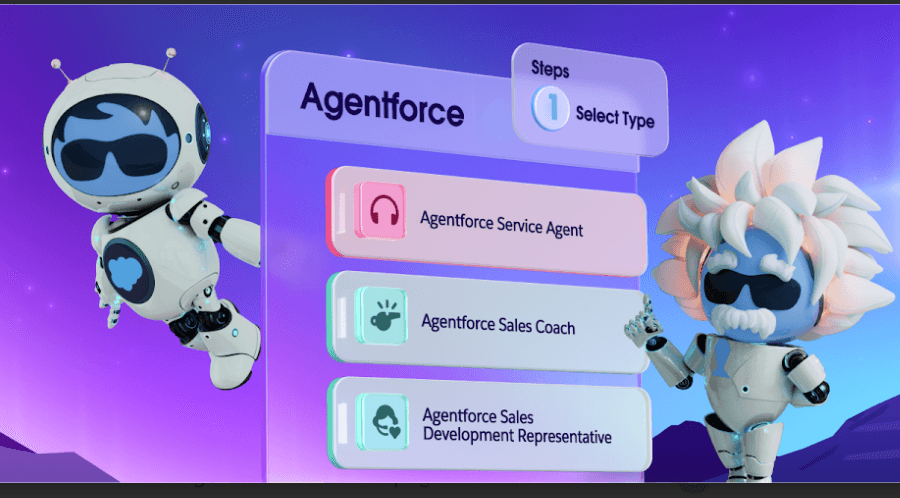
At Vurtuo, our preferred architecture pipeline for Agentforce deployments runs External Service to Invocable Action to Agent Action. Each layer has a defined responsibility. External Services handle the API contract with the outside world. Invocable Actions encapsulate the business logic and error handling. Agent Actions expose a clean, reliable surface to the orchestrator. When something breaks, the layer it broke in is immediately identifiable.
This kind of layered architecture also makes the system maintainable. When a downstream API changes its contract, the fix happens at the External Service layer without touching the agent logic. When business rules change, they change at the Invocable Action layer without requiring a redeployment of the agent configuration. Separation of concerns in agent architecture is not academic -- it directly affects how fast the system can evolve.
The Organizational Side of the Problem
Technology is only part of what keeps pilots from reaching production. The organizational side is equally important and less frequently addressed.
Production AI requires ownership. Someone has to own the agent's behavior, the data it depends on, the integrations it uses, and the errors it generates. In most organizations, that ownership is unclear. The AI team built the prompt. The IT team owns the API. The business team owns the process. Nobody owns the system end to end, which means nobody is accountable when it breaks.
Establishing clear ownership -- including escalation paths, SLAs for agent-related incidents, and a defined review cadence for agent performance -- is as important as any technical decision. The organizations closing the pilot-to-production gap in 2026 are the ones that treat AI agents like production software systems, with all the operational discipline that implies.
The businesses that will win on AI this year are not the ones with the most pilots. They are the ones that have done the hard integration work to put agents in production and keep them there.